A Look at Why Medical Professionals Should Never Stop Reading
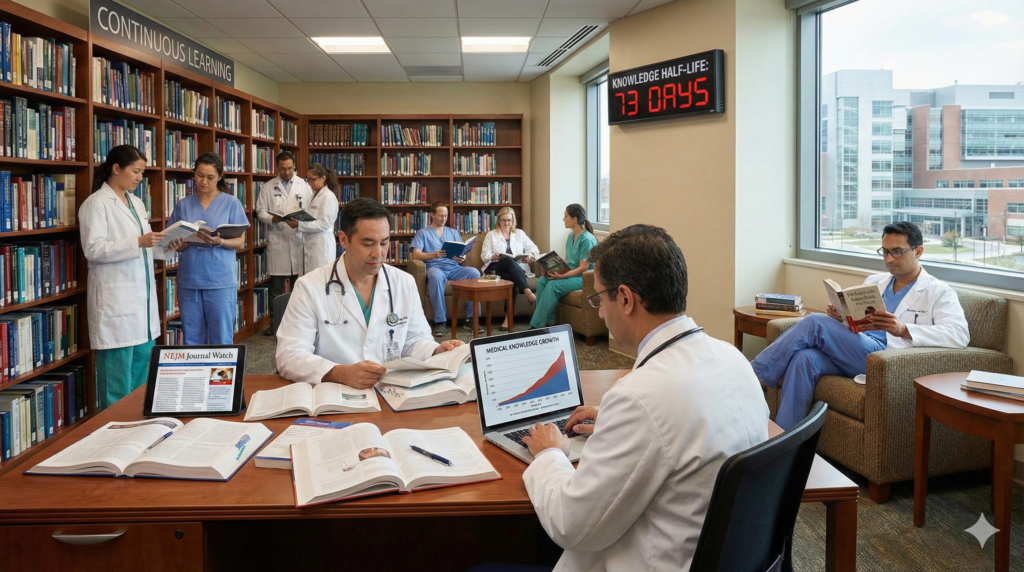

There is a terrifying statistic that often floats around medical schools: the half-life of medical knowledge. In 1950, it was estimated that it took 50 years for the total amount of medical knowledge to double. By 2010, that time had shrunk to 3.5 years. Today? Some estimates suggest it’s less than three months.
For a physician or nurse practitioner, this is an anxiety-inducing reality. It means that a significant portion of what you learned in training could be obsolete, or at least incomplete, within a few years of graduation. The treatment protocols change, the pharmacology evolves, and new technologies rewrite the standard of care overnight.
Staying competent in this environment requires more than just showing up for rounds. It requires a relentless commitment to self-education. While attending conferences and networking through a professional medical society are incredible ways to stay connected to local trends and policy changes, the daily trench warfare against obsolescence is fought in the pages of journals, books, and newsletters.
Reading isn’t just a hobby for medical professionals; it is a patient safety mechanism. Here is how cultivating a dynamic reading habit keeps you sharp, empathetic, and sane in a high-pressure industry.
1. Fighting the Filter Failure
The problem today isn’t a lack of information; it’s too much of it. If you tried to read every article published in your specialty, you would need more hours than exist in a day. This leads to what information scientists call filter failure.
Successful medical professionals don’t try to read everything. They learn how to curate.
- The Aggregators: Instead of visiting twenty different journal websites, smart practitioners rely on curated newsletters (like NEJM Journal Watch or specialty-specific digests) that summarize the must-know studies of the week.
- The Abstract Habit: You don’t need to read the full text of every study. Mastering the art of quickly scanning the abstract, the methodology, and the conclusion allows you to triage information. Does this apply to my patient demographic? Is the sample size significant? If yes, dive deep. If no, file it away and move on.
By treating your reading list like a diet, you ensure you are consuming high-nutrient information rather than just junk data.
2. Reading Outside the Clinical Bubble
If you only read clinical guidelines and pathology textbooks, you might become a great technician, but you might struggle to be a great healer.
Medicine is arguably as much about sociology and psychology as it is about biology. Reading outside the scope of clinical medicine helps bridge the gap between the diagnosis and the human being sitting on the exam table.
- The Business of Medicine: Understanding the economics of healthcare helps you navigate insurance hurdles for your patients.
- Memoirs and Humanities: Reading patient narratives or memoirs written by other physicians (think Atul Gawande or Paul Kalanithi) reminds you of the emotional weight of illness. It combats compassion fatigue. When you read a well-written story about a patient’s struggle with a chronic condition, it re-humanizes the data. It reminds you that the non-compliant patient in Room 3 is actually a terrified person navigating a complex system.
3. Critical Appraisal: The Best Defense Against Hype
We live in the era of the headline cure. Patients come into the office clutching a printout from a news website claiming that a specific berry cures cancer or that a new drug is a miracle worker.
When you make a habit of reading actual studies—not just the news reports about them—you start to spot the flaws. You notice that a breakthrough was only tested on mice. You notice when the statistically significant result has zero clinical relevance. This skill, often called critical appraisal, allows you to guide your patients through the noise. You become an interpreter, translating complex (and often conflicting) data into advice they can trust.
4. The Micro-Learning Shift
The days of sitting down for two hours with a physical medical journal are largely gone for busy attendings and residents. The modern approach is micro-learning.
This is reading in the margins of life.
- The Commute: Audiobooks and medical podcasts have revolutionized how professionals read. Listening to a breakdown of new cardiology guidelines while driving to the hospital turns dead time into productive time.
- The Phone Check: Instead of scrolling social media between patients, having a medical app or a saved article ready to go allows for 3-minute bursts of education.
This isn’t about cramming; it’s about consistency. A doctor who reads for fifteen minutes a day will always outpace the doctor who tries to binge-read for five hours once a month.
5. Preventing Burnout Through Escapism
Finally, we have to talk about reading that has absolutely nothing to do with medicine. Burnout is the other pandemic in healthcare. The emotional toll of making high-stakes decisions every day can leave you hollow. Reading fiction, history, or sci-fi offers a necessary mental exit ramp.
When you are deep in a mystery novel or exploring a historical biography, your brain is disengaged from the hospital. You aren’t “Dr. Smith”; you are just a reader lost in a story. This cognitive break is essential for recovery. It lowers cortisol levels and helps you sleep, ensuring that when you do put the white coat back on, you are rested enough to handle whatever walks through the door.
In medicine, graduation day is not the finish line. It is just the start of a forty-year independent study project.
The tools change. The guidelines shift. The viruses mutate. The only constant is the need to learn. By building a reading habit that is diverse, critical, and consistent, you ensure that your knowledge base grows as fast as the industry does. You owe it to your career, but more importantly, you owe it to the patients trusting you with their lives.

About Author