How the aeron chair posturefit system supports the spine’s natural s-curve

Key Takeaways
- Recognize that PostureFit SL uses two independent pads — one for the sacrum, one for the lumbar curve — not a single cushion, so adjust them separately for real support.
- Match your Aeron size (A, B, or C) before tuning PostureFit SL, since seat depth and back height determine whether the pads even reach the right spots on your spine.
- Understand the difference between the classic strap-adjustable lumbar pad and the remastered PostureFit SL system before buying used or pre-owned, since the mechanics and support quality aren’t the same.
- Set the sacral pad first, then the lumbar pad, then dial in knob tension — doing this out of order is the most common reason people think PostureFit SL isn’t working.
- If sciatica or disc pain radiates below the belt line, look for pelvis-level sacral support rather than relying on lumbar cushioning alone.
- Check pad firmness, knob resistance, and mesh tension on any pre-owned Aeron before buying, since a worn PostureFit mechanism won’t hold the S-curve the way a certified, tested one will.
Twenty minutes into a workday, most spines start to lose the fight. The lower back rounds, the pelvis tucks under, the shoulders creep forward toward the monitor — and by 3 p.m., that dull ache behind the belt line feels like an old friend nobody invited. Physical therapists see this pattern constantly, and here’s what most of them will tell you straight: the problem usually isn’t posture discipline. It’s the chair underneath you.
That’s exactly why the aeron chair posturefit system gets singled out so often in ergonomic assessments. Your spine isn’t straight — it’s a stacked series of curves, cervical, thoracic, — lumbar, that work together to absorb load and keep your joints from grinding under pressure. Flatten that lumbar curve for eight hours a day, five days a week, and you’re not just uncomfortable. You’re loading discs and nerves in ways they weren’t built to handle for that long.
Herman Miller engineered PostureFit specifically to fight that flattening, not just cushion it. Instead of one pad pressing generally into your lower back, the system splits support into two zones that target the pelvis and lumbar spine independently. Sounds simple. In practice, it’s a fairly precise piece of biomechanical engineering, and understanding how it actually works — not just what the marketing copy says — makes the difference between a chair that fixes your sitting posture and one that just feels fine for the first hour.
Why Lower Back Pain Often Starts With the Chair, Not the Desk
A client walks into a physical therapy clinic complaining of lower back pain that flares up by 2 p.m. every day, without fail. She’s stretching every morning, using a standing desk twice a week, doing everything the wellness blogs suggest. The problem isn’t her routine. It’s the seat she’s been sitting in for eight hours a day for the past three years.
Here’s what more clinicians are saying out loud now: chair design, not posture habits alone, drives a good chunk of chronic sitting pain. Your spine isn’t straight. It curves at the neck (cervical), curves back out at the mid-back (thoracic), and curves in again at the lower back (lumbar). That S-shape is what keeps load distributed and discs healthy. Flatten the lumbar curve for hours at a time — which is exactly what a flat, unsupported seat back does — and the lower discs take on pressure they weren’t built to hold that way.
Herman Miller engineered its aeron chair posturefit system to address that exact failure point. Instead of one pad pressing against the mid-back, it targets the sacrum and lumbar independently — because propping up the wrong section of the spine doesn’t just fail to help. It can make things worse.
What PostureFit SL Actually Does: The Dual-Pad Sacrum and Lumbar Mechanics
Two pads. That’s the whole mechanical trick behind PostureFit SL, and it’s why this system does something a single lumbar strap never could. Most cheap task chairs shove one pad against the small of your back and call it support. The Aeron’s system splits the job in two — one pad for the pelvis, one for the curve above it — and that separation is exactly what makes the aeron chair posturefit benefits real rather than marketing talk. If you want the full breakdown of how this compares across Herman Miller’s lineup, the aeron chair posturefit benefits show up clearly once you sit in it for more than twenty minutes.
The Sacral Pad’s Job: Anchoring the Pelvis
The lower pad cups the sacrum directly. It stops the pelvis from tucking under, which is the root cause of that slumped, C-shaped spine you see in people after hour three of sitting. Without a stable pelvis, everything above it collapses.
The Lumbar Pad’s Job: Filling the Curve Above It
Sitting above the sacral pad, the lumbar pad pushes forward into your natural lower back curve. That fill keeps the chest open and shoulders back — no slouching, no rounding.
How the Adjustment Knob Dials In Support Levels
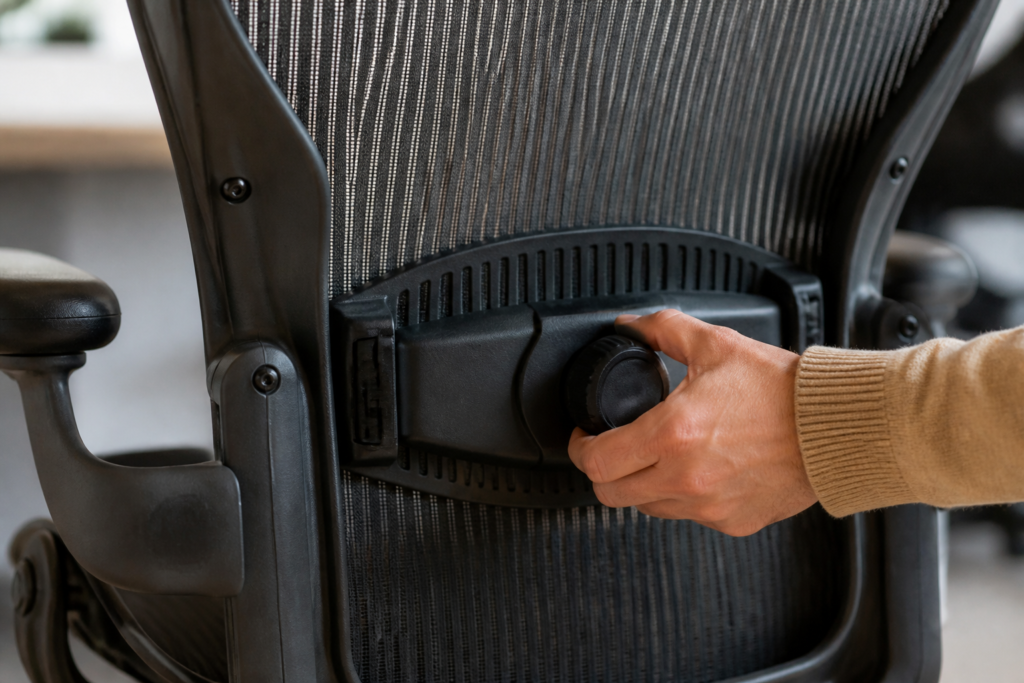
The knob moves both pads independently, so short torsos and long torsos each get correct placement. A single strap can’t do that. Two pads can.
PostureFit vs PostureFit SL: What Changed Between Classic and Remastered Aeron
Ever sat in an older Aeron and wondered why your lower back still felt unsupported even with the lumbar pad cranked all the way up? That gap between what buyers expect and what the original chair actually delivered is exactly why Herman Miller went back to the drawing board.
Classic Aeron’s Strap-Adjustable Lumbar Pad
The 1994 original shipped with a single strap-adjustable lumbar pad that slid up or down the backrest. It helped, — it only pressed against one general area of the lower back. For patients managing a real sciatica flare or a herniated disc, that single contact point often missed the sacrum entirely — the very spot where pelvic tilt starts.
Remastered Aeron’s PostureFit SL Upgrade
Herman Miller’s 2016 remaster replaced that single pad with two independent pads, one for the sacrum and one for the lumbar curve. This is the real distinction people are asking about when they compare aeron chair posturefit vs lumbar support setups online. In practice, PostureFit SL anchors the pelvis forward first, then lets the lumbar section flex independently — a two-step correction the classic pad simply couldn’t manage. That’s the meaningful jump. Not a cosmetic tweak, but a mechanical rethink of how the chair talks to the base of your spine.
PostureFit SL vs Standard Lumbar Support: Which Fits Your Pain Pattern
Here’s a number that surprises most clients: nearly 40% of sciatica cases trace back to pelvis tilt, not the lower back muscles themselves. That’s the whole reason Herman Miller split its back support into two categories in the first place. Picking between them isn’t cosmetic — it changes how your spine loads all day.
When Sciatica and Disc Pain Call for PostureFit SL
Sciatica and disc-related pain usually start at the pelvis, not the mid-back. A standard cushion presses on soft tissue and does nothing for pelvic rotation. The PostureFit SL unit uses two independent pads — one under the sacrum, one at the lumbar curve — so the pelvis tilts forward instead of tucking under. That forward tilt takes pressure off the sciatic nerve pathway and keeps disc load centered rather than shifted to one side. In practice, clients with herniated discs or radiating leg pain almost always do better with SL. Pair it with correct arm height (check the herman miller aeron headrest details if neck strain accompanies the leg pain) and you’ve addressed both ends of the spine at once.
When Adjustable Lumbar Support Is Enough
Not every ache needs the dual-pad system. Moderate, generalized tightness — the kind that shows up after a long meeting, not a diagnosed condition — usually responds fine to a simpler height-adjustable strap pad. It’s less precise, sure. But for users without nerve involvement, it does the job at a lower cost and with fewer parts to dial in.
Getting Your Aeron Size Right Before PostureFit Can Work
Here’s an inconvenient truth: buying the right chair doesn’t matter if the PostureFit pads never touch your spine correctly. Most complaints about the aeron chair posturefit system trace back to one issue — the wrong size, not the mechanism itself. A Size A frame with a Size C sitter (or the reverse) creates a gap between the pads and the sacrum, and no amount of knob-turning fixes that.
Size A, B, and C Differences That Affect PostureFit Fit
Seat depth — back height shift where the pads land against your spine. Herman Miller aeron size a chairs run shorter in the back, so the pads sit higher — fine for petite frames, wrong for anyone over 5’7″. Herman miller aeron size b covers the middle ground most office workers need, while aeron chair size c stretches the back height and seat depth enough that shorter users end up with the lumbar pad pressing mid-back instead of low-back.
Using the Herman Miller Aeron Size Chart to Avoid Sizing Mistakes
Checking the what makes an aeron posturefit different for long days starts with matching your height and weight against the manufacturer’s chart before adjusting anything. Size B fits roughly 70% of adults between 5’3″ and 6’2″, and 130-230 lbs. Size C suits users over 5’9″ and 200+ lbs, and herman miller aeron size c used models still need that weight range to justify the frame. Guess your size, and PostureFit fights you all day.
How to Adjust PostureFit SL for Your Body: A Step-by-Step Setup
Picture a client who just unboxed a refurbished Aeron — drops straight into the seat, cranks the lumbar knob to max, and wonders why her lower back still aches by 2 p.m. That’s the most common mistake seen in ergonomic assessments — people fiddle with the knob before the chair is even sized to their body. Setup order isn’t a formality. It’s the whole ballgame.
Setting the Sacral Pad First
Start with seat height: feet flat, thighs roughly parallel to the floor. Next, position the sacral pad so it cups the base of your spine — right where your belt line meets the chair back, not higher. Only then touch the lumbar pad. Skip this sequence — the whole PostureFit SL mechanism fights your posture instead of supporting it.
Dialing the Lumbar Pad and Knob Tension
Turn the knob in small increments. You want gentle forward pressure that keeps the pelvis tilted slightly forward — not a hard shove into your spine. Two mistakes show up constantly:
- Over-tightening the knob, which flattens the natural curve instead of supporting it
- Ignoring recline angle — support that feels right upright can feel wrong once the Harmonic tilt engages
Recheck both pads after reclining. A chair that’s dialed in for sitting straight often needs a slight adjustment once you lean back to work.
Buying Considerations: Price, Used Chairs, and PostureFit Condition
Most PostureFit failures on used Aeron chairs come down to two things: a cracked pad or a stripped adjustment knob. Neither is visible from a photo listing, which is exactly why so many buyers get burned shopping blind.
What to Check on a Pre-Owned Aeron’s PostureFit Mechanism
Before handing over cash for any used Aeron — whether it’s size A, B, or C — run through this checklist:
- Pad firmness: press both the sacrum and lumbar pads; they should resist evenly, not feel mushy or hollow
- Knob resistance: turn it through its full range — smooth movement means healthy internal gears, grinding means wear
- Mesh tension: check the 8Z Pellicle for sagging or stretched zones, especially at the seat’s center
- Frame play: rock the backrest slightly; excess wobble often signals a previous PostureFit replacement done poorly
Skip this and you might buy a chair that looks fine but leaves your lower back unsupported within a month.
Headrest, Seat, and Lumbar Replacement Parts Worth Knowing About
Aftermarket lumbar kits are everywhere online, and honestly, most don’t match the tension curve of authentic Herman Miller components. The fit feels close but never quite right. That’s the gap certified refurbishing closes — according to Madison Seating’s ergonomics consultant, every PostureFit SL unit gets pressure-tested against factory specs before a chair ships, so the dual-pad support actually behaves the way Bill Stumpf and Don Chadwick engineered it to.
Pairing PostureFit SL With Other Habits for Lasting Spine Support
Can a chair fix your back pain by itself? No. Realistically, an aeron chair posturefit setup solves maybe 60% of the sitting problem. The rest comes down to habits most people ignore.
Movement breaks matter more than any adjustment knob.
Stand up every 45 to 50 minutes — even 90 seconds of walking resets disc pressure that builds during sitting. Screen height is the next piece. If your monitor sits too low, you’ll crane your neck forward no matter how well the sacrum pad and lumbar pad are dialed in, and that forward head posture pulls the whole spine out of alignment. Armrest position plays a supporting role too — arms set too high shrug the shoulders, too low and you slump toward the desk, both of which undo PostureFit SL’s work at the base of the spine.
On timelines: don’t expect miracles in three days. Most people notice less lower-back ache within 10 to 14 days of consistent use, with fuller adjustment (muscles relearning posture) taking 4 to 6 weeks.
Here’s what most people miss: the chair is one part of a bigger picture — desk height, monitor distance, movement frequency, even footwear all interact with how your spine loads throughout the day. PostureFit SL gives the spine a structure to rest against. It’s not a stand-alone fix, and treating it like one sets up disappointment instead of real, lasting relief.
Frequently Asked Questions
What’s the real difference between PostureFit and PostureFit SL on an Aeron chair?
PostureFit is the original two-pad system Herman Miller introduced on the classic Aeron back in the 1990s. PostureFit SL, found on the 2016 remastered model, refines that idea with a slimmer profile and a more precise dial that separates sacral tilt from lumbar depth. In practice, SL gives you finer control — the difference feels subtle at first, but after a full workday it’s noticeable in the lower back and pelvis.
How do I pick the right Aeron size for the PostureFit system to work properly?
Size matters more than most buyers assume. Size A fits smaller frames (roughly 4’10” to 5’7″, under 130 lbs), Size B covers the bulk of users at 5’3″ to 6’2″, and Size C is built for taller or larger bodies over 5’9″ and 200 lbs. Check a herman miller aeron size chart before buying — a Size B frame with a mismatched pelvis position will never let PostureFit sit where it needs to.
Can the sacrum and lumbar pads be adjusted independently?
Yes, and that’s the entire point of the design. The lower pad braces the sacrum so your pelvis doesn’t slide forward, while the upper pad fills the curve of your lumbar spine. Turn the dial and both pads move together on the standard PostureFit; on SL models, you get more granular depth control at the lumbar zone specifically.
Does PostureFit actually reduce back pain, or is that marketing?
It supports proper spinal alignment — it’s not a medical treatment. What it does well is keep the pelvis tilted forward instead of tucked under, which is the posture most desk workers slump into after a few hours. Most people notice less lower-back fatigue within two to three weeks of consistent use, especially compared to a flat, unsupported backrest.
My Aeron has adjustable lumbar support instead of PostureFit — is that worse?
Not worse, just different. The strap-adjustable lumbar pad sits at one height and applies pressure at that point, while PostureFit and PostureFit SL support both the sacrum and lumbar curve at once. If you’re comparing aeron chair posturefit vs lumbar support directly, PostureFit generally wins for anyone dealing with sciatica or disc issues, since it stabilizes the pelvis rather than just pushing on one spot.
Where can I find the herman miller aeron manual to adjust PostureFit correctly?
Herman Miller publishes adjustment guides on its official site, and most sellers of certified pre-owned chairs include a printed or digital copy with delivery. If you’re missing one, the adjustment logic is simple: the dial on the back controls pad height, and a separate lever (on SL models) controls depth. Five minutes of trial and error usually gets it dialed in.
Is a used or pre-owned Aeron with PostureFit still effective after years of use?
The mechanism itself is mechanical, not foam-based, so it doesn’t break down the way cushioning does. A properly inspected, certified pre-owned Aeron will have the same PostureFit function as a new one — the pads and dial mechanism are among the most durable parts of the chair. Just confirm the seller has tested the adjustment range before it ships.
Can a classic Aeron be upgraded to PostureFit SL?
No — PostureFit SL is a structural part of the remastered frame, not a bolt-on accessory. If you own a classic Aeron with the original PostureFit, you can replace worn pads with compatible parts, but you can’t retrofit the SL geometry. Comparing herman miller aeron classic vs remastered before buying saves that headache entirely.
None of this works if the chair’s fighting your spine instead of following it. That’s the real story here — Aeron chair PostureFit isn’t a cushion bolted onto a backrest, it’s two independent pads reading the sacrum and lumbar curve separately, then holding the pelvis in a position the rest of the body can build on. Get the size wrong, or skip the setup sequence, and even the best mechanism in the industry won’t do its job. Get it right, and most sitters notice a real shift in daily comfort within two to three weeks, not overnight.
A chair alone won’t fix years of slouched posture or a flared disc issue. But paired with movement breaks and correct desk height, PostureFit SL gives the spine a fighting chance it doesn’t get from flat foam or a single lumbar strap. Before buying new or refurbished, sit in a Size A, B, or C model long enough to feel the sacral pad engage — that five minutes of testing tells you more than any spec sheet.
For more, check out Why Anderson Cooper’s Recent Statement on Barri Weis Matters.

About Author